WASHINGTON: Hundreds of soldiers at
Fort Benning are now getting their temperatures checked using the Army’s prototype targeting goggles. The Army made this latest modification in just four days to the rapidly evolving
Integrated Visual Augmentation System. This program shows how quickly the Army can innovate – but it also shows the limits of ad hoc solutions to the global COVID-19 pandemic.
IVAS has been a poster child for the Army’s effort
to overhaul its notoriously troubled acquisition system. Instead of a decades-long, multi-billion-dollar development program, this
program started just two years ago and is
on track, despite the pandemic, to
deliver over 40,000 devices to combat troops next year. How? The Army started with an off-the-shelf commercial product, the Microsoft HoloLens, then ran it through round after round of field trials, with soldiers and engineers working side by side to fix problems, make upgrades, and test the changes
at a pace that dazzled the general in charge.
One week ago, according to an Army announcement, the science & technology director on the IVAS project, Tom Bowman of the Fort Belvoir, Va.
night vision lab, realized the system’s built-in infrared sensor could be used to read a person’s body temperature from a safe distance. Microsoft engineers made a few adjustments to the software and in those four short days, the first modified IVAS prototypes arrived at Fort Benning.
The Army also decided it was safest to do a quick recalibration of each system after 10 tests to ensure it was reading correctly. Even so, one group of 300 soldiers was processed in less than half an hour.
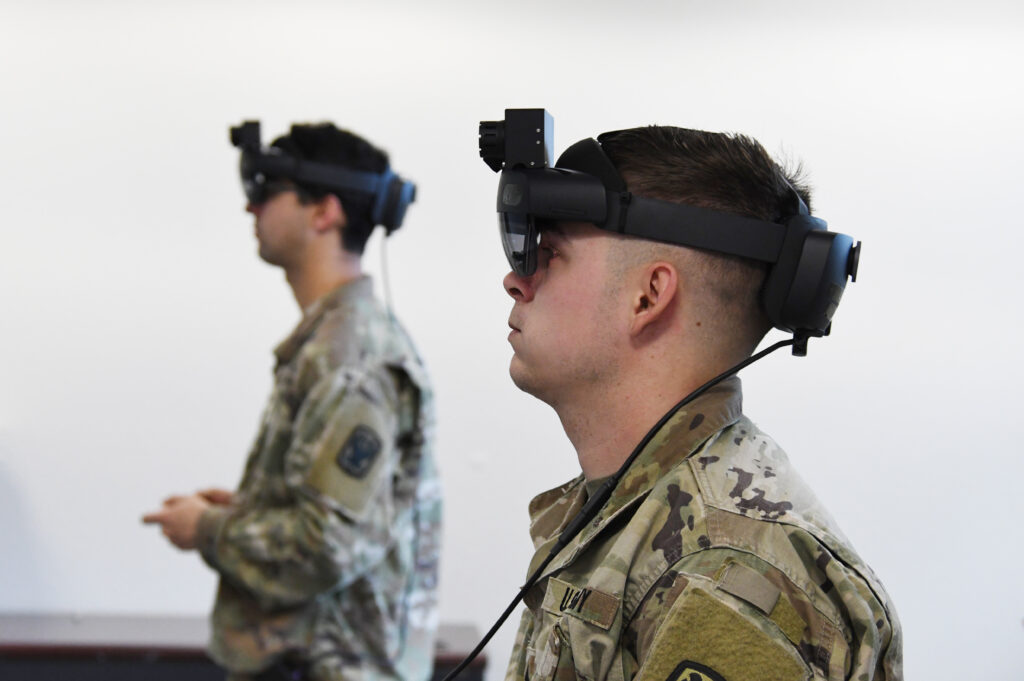
Soldiers wearing prototype IVAS targeting goggles.
What Is IVAS?
IVAS will combine a host of new and existing technologies that previously required distinct devices into a single headset:
- Binocular night vision, with both infrared sensors to spot vehicle engines and human body heat – the key to the COVID-19 application – and visual-light intensification.
- A tactical Heads-Up Display that links to the soldier’s gunsight and the unit’s tactical network, superimposing a cross-hairs, compass directions, pointers to objectives and friendly troops, and other data as desired onto their field of vision.
- An on-demand video link to what the unit’s reconnaissance drones are seeing.
- A digital atlas of the planet, updated on demand by mapping drones, to help plan missions in 3D detail.
- An augmented reality training system that lets a soldier “fight” realistic virtual enemies as he moves around real obstacles, like a militarized version of Pokémon Go.
Comments
Post a Comment